

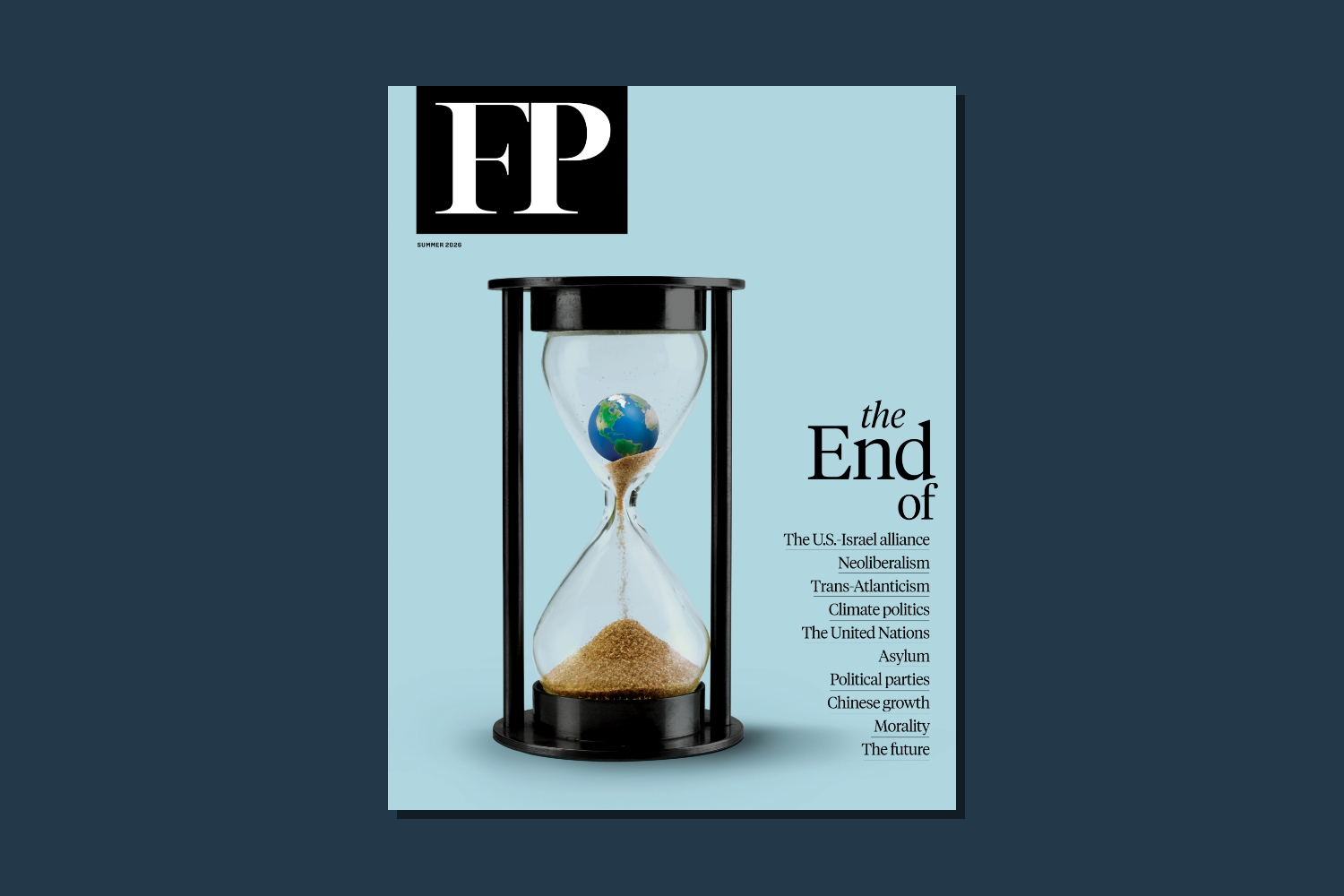
Introducing the Summer 2026 Print Issue
The end of the world as we know it.
By Ravi" target="_blank" rel="noopener noreferrer nofollow">https://foreignpolicy.com/author/ravi-agrawal/">Ravi Agrawal, the editor in chief of Foreign Policy.- Geopolitics
- Economics
- Climate Change
- Ravi Agrawal
Remember the R.E.M. song “It’s the End of the World as We Know It (And I Feel Fine)”? It’s been in my head recently. The track was released in November 1987, about a month before U.S. President Ronald Reagan and Soviet leader Mikhail Gorbachev signed an arms control treaty that set the stage for the end of the Cold War. Michael Stipe, the band’s frontman, has said the idea came to him after a deep sleep. But its resonance with listeners could have been because it came at the end of a worrying time for the world, right before a geopolitical dawn. It’s not so far from the “end of the world” to the “end of history,” a term this magazine’s readers know all too well.
Long after the fall of the Berlin Wall and the optimistic pop sounds of the ’90s that came with it, this particular R.E.M. song has endured as an earworm—and a recurring vibe. It made a brief comeback around December 2012, when people worldwide seized on the idea of a Maya-predicted apocalypse. And then the track reportedly saw a surge in streaming during the COVID-19 pandemic. Now, in 2026, I would wager that songs about the end of the world are once again back in vogue, neatly mirroring news of endless war and its accompanying crises of food, energy, inflation, migration, and much else.
Remember the R.E.M. song “It’s the End of the World as We Know It (And I Feel Fine)”? It’s been in my head recently. The track was released in November 1987, about a month before U.S. President Ronald Reagan and Soviet leader Mikhail Gorbachev signed an arms control treaty that set the stage for the end of the Cold War. Michael Stipe, the band’s frontman, has said the idea came to him after a deep sleep. But its resonance with listeners could have been because it came at the end of a worrying time for the world, right before a geopolitical dawn. It’s not so far from the “end of the world” to the “end of history,” a term this magazine’s readers know all too well.
Long after the fall of the Berlin Wall and the optimistic pop sounds of the ’90s that came with it, this particular R.E.M. song has endured as an earworm—and a recurring vibe. It made a brief comeback around December 2012, when people worldwide seized on the idea of a Maya-predicted apocalypse. And then the track reportedly saw a surge in streaming during the COVID-19 pandemic. Now, in 2026, I would wager that songs about the end of the world are once again back in vogue, neatly mirroring news of endless war and its accompanying crises of food, energy, inflation, migration, and much else.
Is this the end of the world as we know it? Is that a good thing or a bad thing? Will it eventually lead, as it did at least once before, to a more hopeful moment?
I can’t claim to have answers. But our Summer" target="_blank" rel="noopener noreferrer nofollow">https://foreignpolicy.com/the-magazine/?issue_id=411227090">Summer 2026 issue has plenty of food for thought. We’ve put together a collection" target="_blank" rel="noopener noreferrer nofollow">https://foreignpolicy.com/projects/the-end-of-the-world-as-we-know-it/">collection of 10 essays that explore trends, ideas, and geopolitical cornerstones that are falling apart—slowly yet seemingly all at once.
Joshua" target="_blank" rel="noopener noreferrer nofollow">https://foreignpolicy.com/2026/06/15/israel-united-states-special-relationship-palestine-netanyahu-trump/">Joshua Leifer examines how the once unshakeable U.S.-Israel alliance has “entered a period of terminal decline.” Nathalie" target="_blank" rel="noopener noreferrer nofollow">https://foreignpolicy.com/2026/06/15/trans-atlanticism-europe-united-states-mark-carney-davos-nato/">Nathalie Tocci goes a step further, arguing that the relationship between the United States and Europe—the bedrock of a liberal international order—is gone. It won’t come back, Tocci says, no matter who takes U.S. President Donald Trump’s place in a few years. James" target="_blank" rel="noopener noreferrer nofollow">https://foreignpolicy.com/2026/06/15/united-nations-obituary-gaza-ukriane-trump/">James Traub has long covered the United Nations and tells the story of that visibly shrunken global body, a fall accelerated by Washington and its changing priorities.
What will the world look like without these partnerships and organizations? Much will depend on how countries navigate the moment. Anton" target="_blank" rel="noopener noreferrer nofollow">https://foreignpolicy.com/2026/06/15/party-democracy-political-system-participation-membership-leaders-elections-voting/">Anton Jäger points out the declining role of political parties, which he sees as “increasingly anachronistic,” as one thing to keep an eye on. Parties and publics will need to reckon with where things went wrong, including with neoliberalism, Branko" target="_blank" rel="noopener noreferrer nofollow">https://foreignpolicy.com/2026/06/15/neoliberalism-globalization-competition-cosmopolitanism-economics-reagan-thatcher/">Branko Milanovic writes. Young voters around the world will no doubt ask why they have been left to navigate a climate disaster, a scenario that Leah" target="_blank" rel="noopener noreferrer nofollow">https://foreignpolicy.com/2026/06/15/climate-change-paris-cop30-china-green-energy/">Leah Aronowsky grapples with as she looks at how Westerns elites failed to come up with a plan to deal with civilization’s greatest threat. The problem might be systemic: Collective action is tougher to come by given that international law is weaker than it has been in decades, according to Rosa" target="_blank" rel="noopener noreferrer nofollow">https://foreignpolicy.com/2026/06/15/international-law-decline-united-nations-security-council-morality-legal-institutions-west/">Rosa Brooks, who calls this trend not just a moral loss but a “structural catastrophe.” Just consider how the right to asylum now feels like an artifact of a bygone era, as Linda" target="_blank" rel="noopener noreferrer nofollow">https://foreignpolicy.com/2026/06/15/immigration-policy-asylum-refugees-borders-law-trump-united-states-europe/">Linda Kinstler argues.
Some of the old engines of the global economy are petering out. China’s record double-digit growth rates, which powered a commodities boom around the world, are gone forever, FP’s James" target="_blank" rel="noopener noreferrer nofollow">https://foreignpolicy.com/2026/06/15/china-economy-decline-demographic-consumption-gdp-xi-jinping/">James Palmer forecasts. But can we even predict the future anymore? Jonathan" target="_blank" rel="noopener noreferrer nofollow">https://foreignpolicy.com/2026/06/15/future-politics-theory-big-tech-artificial-intelligence-silicon-valley-nihilism/">Jonathan White isn’t so sure, pointing to how people now seem trapped in a sense of fatalism instead of optimism.
You’ll find more questions than answers in this package. Even so, if we hope for a new and better world, I feel we must engage fully with such provocations.
Lots more in this issue, as always, including a timely" target="_blank" rel="noopener noreferrer nofollow">https://foreignpolicy.com/2026/06/09/iran-war-trump-china-united-states-military-defense-weapons-geopolitics-strategy-taiwan/">timely essay by Hal Brands exploring how the Iran war has left the United States overstretched—and an easier target for China. Bracing reads all around, I know, but I hope you’ll enjoy this issue all the same. And for those in the Northern Hemisphere, with a dose of sunshine alongside it.
As ever,
Ravi Agrawal
- Geopolitics
- Economics
- Climate Change
- Ravi Agrawal
Ravi Agrawal is the editor in chief of Foreign Policy. X: http://www.twitter.com/RaviReports" target="_blank">@RaviReports
Read More On https://foreignpolicy.com/tag/alliances/" class="tag"> Alliances |https://foreignpolicy.com/tag/climate-change/" class="tag"> Climate Change |https://foreignpolicy.com/tag/economics/" class="tag"> Economics |https://foreignpolicy.com/tag/geopolitics/" class="tag"> Geopolitics |https://foreignpolicy.com/tag/us-china-competition/" class="tag"> U.S.-China CompetitionJoin the Conversation
Commenting is a benefit of a Foreign Policy subscription.
Already a subscriber? Log In.
Join the Conversation
Join the conversation on this and other recent Foreign Policy articles when you subscribe now.
Not your account? Log out
Join the Conversation
Please follow our https://foreignpolicy.com/comment-guidelines" target="_blank">comment guidelines, stay on topic, and be civil, courteous, and respectful of others’ beliefs.
You are commenting as . Change your username | Log outChange your username:
UsernameI agree to abide by FP’s https://foreignpolicy.com/comment-guidelines" target="_blank">comment guidelines. (Required)
Confirm CANCELConfirm your username to get started.
The default username below has been generated using the first name and last initial on your FP subscriber account. Usernames may be updated at any time and must not contain inappropriate or offensive language.
Username
I agree to abide by FP’s https://foreignpolicy.com/comment-guidelines" target="_blank">comment guidelines. (Required)
Confirm
Comments (0)
No comments yet. Be the first!